
Upper Susquehanna River Watershed Forum – Watershed Wednesdays
Return to the main Watershed Wednesdays page
View past Watershed Wednesdays Content below
2024 Watershed Wednesdays
Our 2024 Watershed Wednesdays series includes 11 mini-webinars addressing Upper Susquehanna River watershed-related topics, conservation initiatives, and ongoing projects. Find session descriptions and webinars below.
September 11th
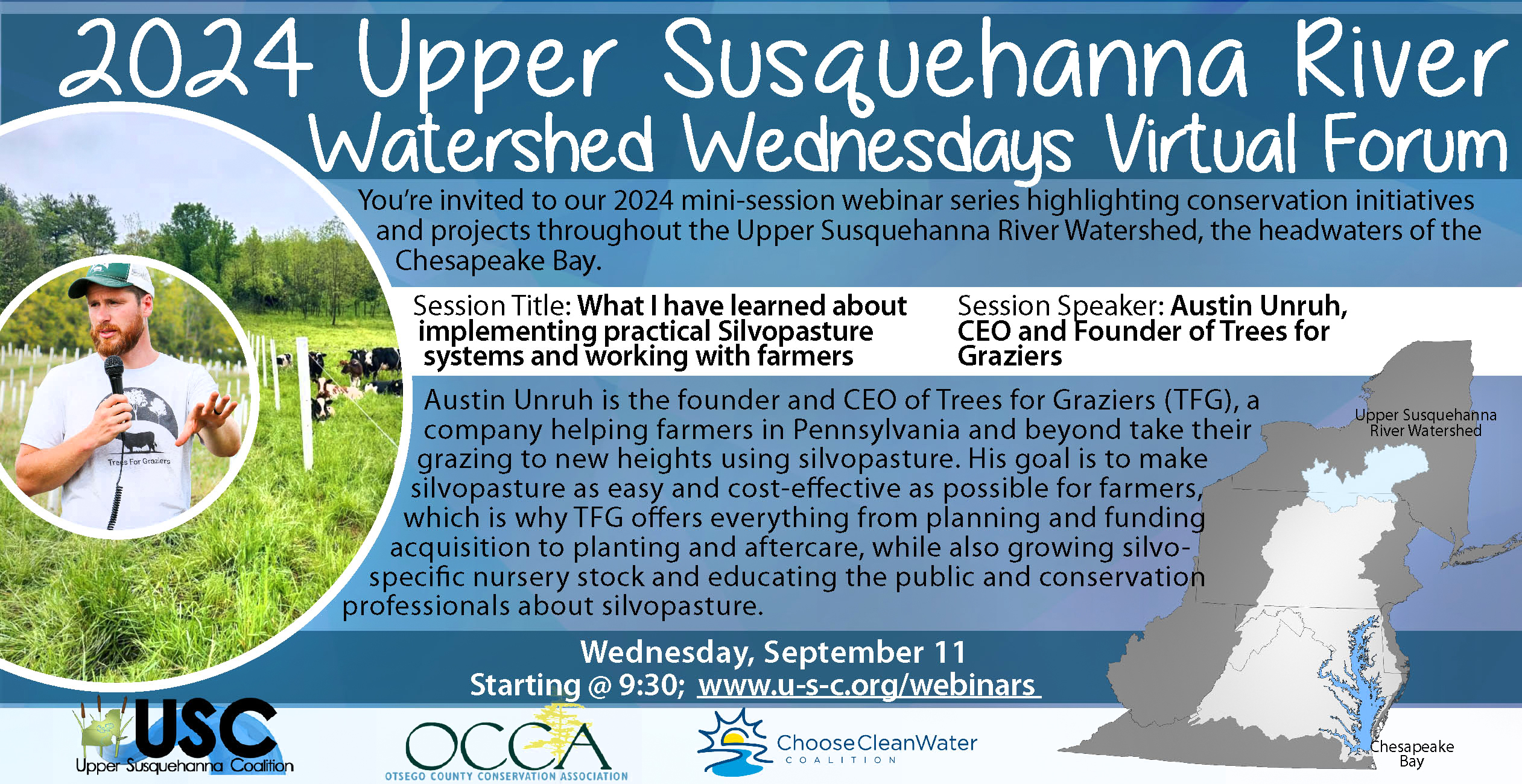
Austin Unruh is the founder and CEO of Trees for Graziers (TFG), a company helping farmers in Pennsylvania and beyond take their grazing to new heights using silvopasture. His goal is to make silvopasture as easy and cost-effective as possible for farmers, which is why TFG offers everything from planning and funding acquisition to planting and aftercare, while also growing silvo-specific nursery stock and educating the public and conservation professionals about silvopasture.
.
.
.
September 18th
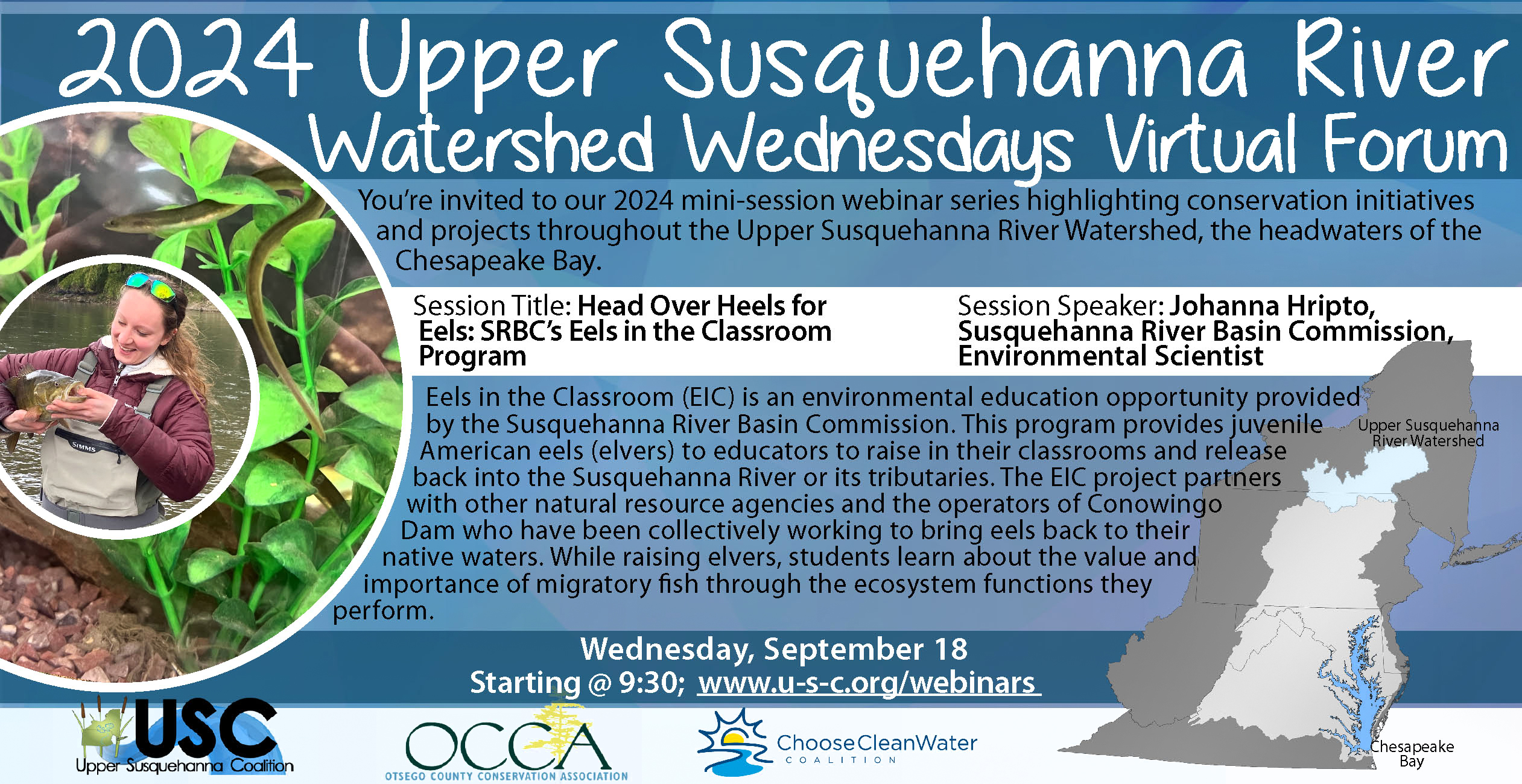
Eels in the Classroom (EIC) is an environmental education opportunity provided by the Susquehanna River Basin Commission. This program provides juvenile American eels (elvers) to educators to raise in their classrooms and release back into the Susquehanna River or its tributaries. The EIC project partners with other natural resource agencies and the operators of Conowingo Dam who have been collectively working to bring eels back to their native waters. While raising elvers, students learn about the value and importance of migratory fish through the ecosystem functions they perform.
Video Links:
http://www.vernalschool.org/the-eels.html#/
https://www.srbc.gov/our-work/american-eels/classroom.html
.
.
.
September 25th
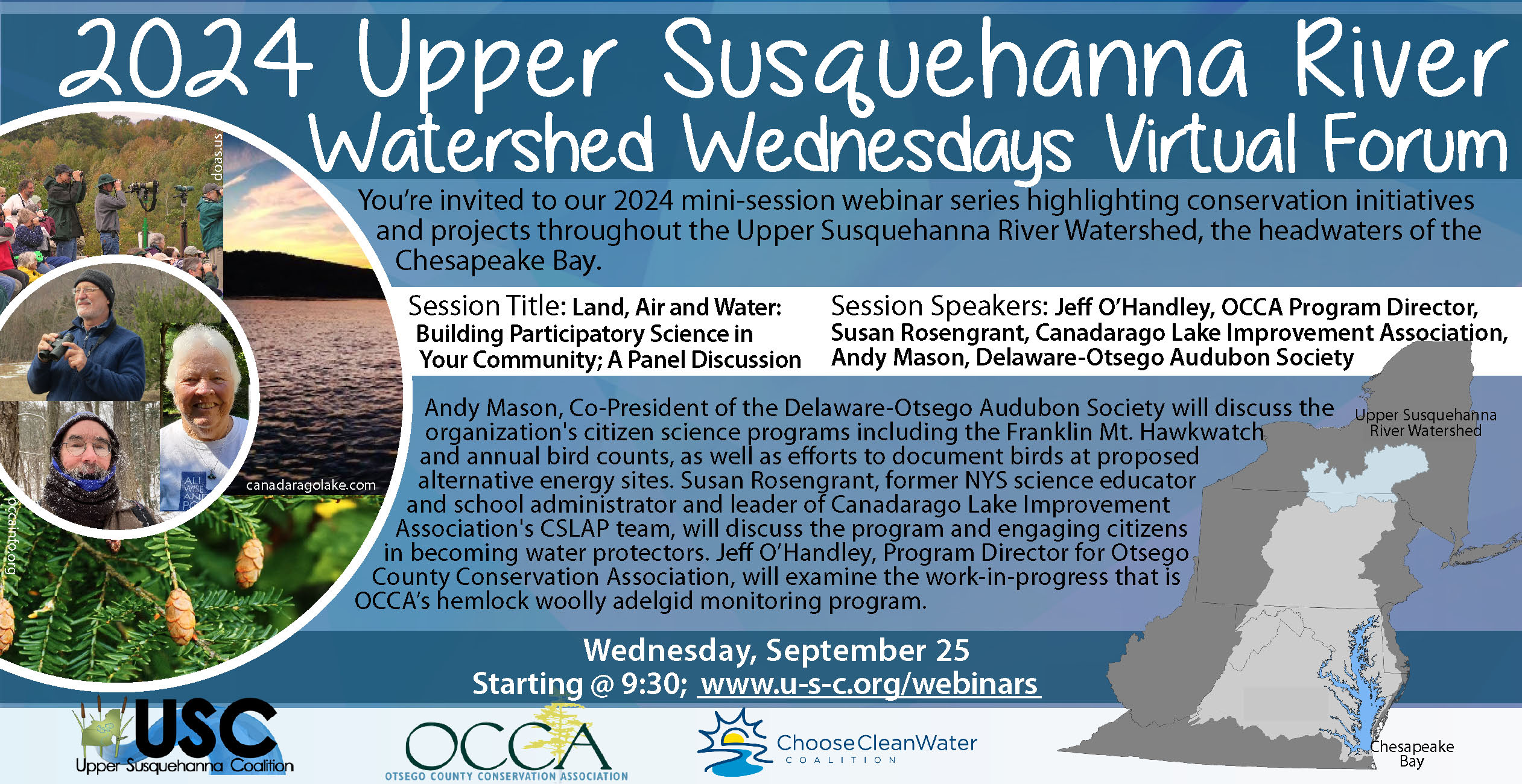
Andy Mason, Co-President of the Delaware-Otsego Audubon Society discusses the organization’s citizen science programs including the Franklin Mt. Hawkwatch and annual bird counts, as well as efforts to document birds at proposed alternative energy sites. Susan Rosengrant, former NYS science educator and school administrator and leader of Canadarago Lake Improvement Association’s CSLAP team, discusses the program and engaging citizens in becoming water protectors. Jeff O’Handley, Program Director for Otsego County Conservation Association, examines the work-in-progress that is OCCA’s hemlock woolly adelgid monitoring program.
.
.
.
October 2nd
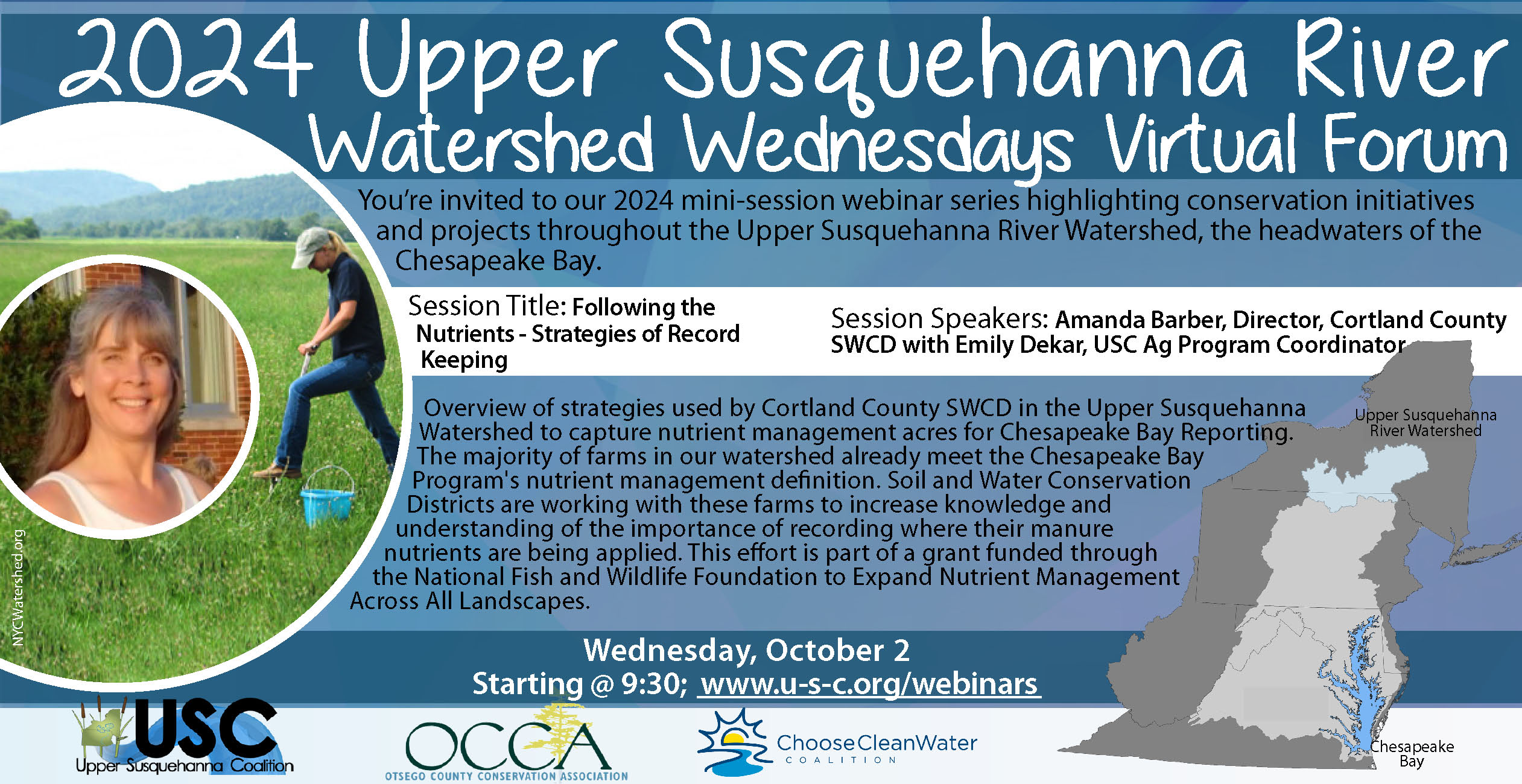
Overview of strategies used by Cortland County SWCD in the Upper Susquehanna Watershed to capture nutrient management acres for Chesapeake Bay Reporting. The majority of farms in our watershed already meet the Chesapeake Bay Program’s nutrient management definition. Soil and Water Conservation Districts are working with these farms to increase knowledge and understanding of the importance of recording where their manure nutrients are being applied. This effort is part of a grant funded through the National Fish and Wildlife Foundation to Expand Nutrient Management Across All Landscapes.
.
.
.
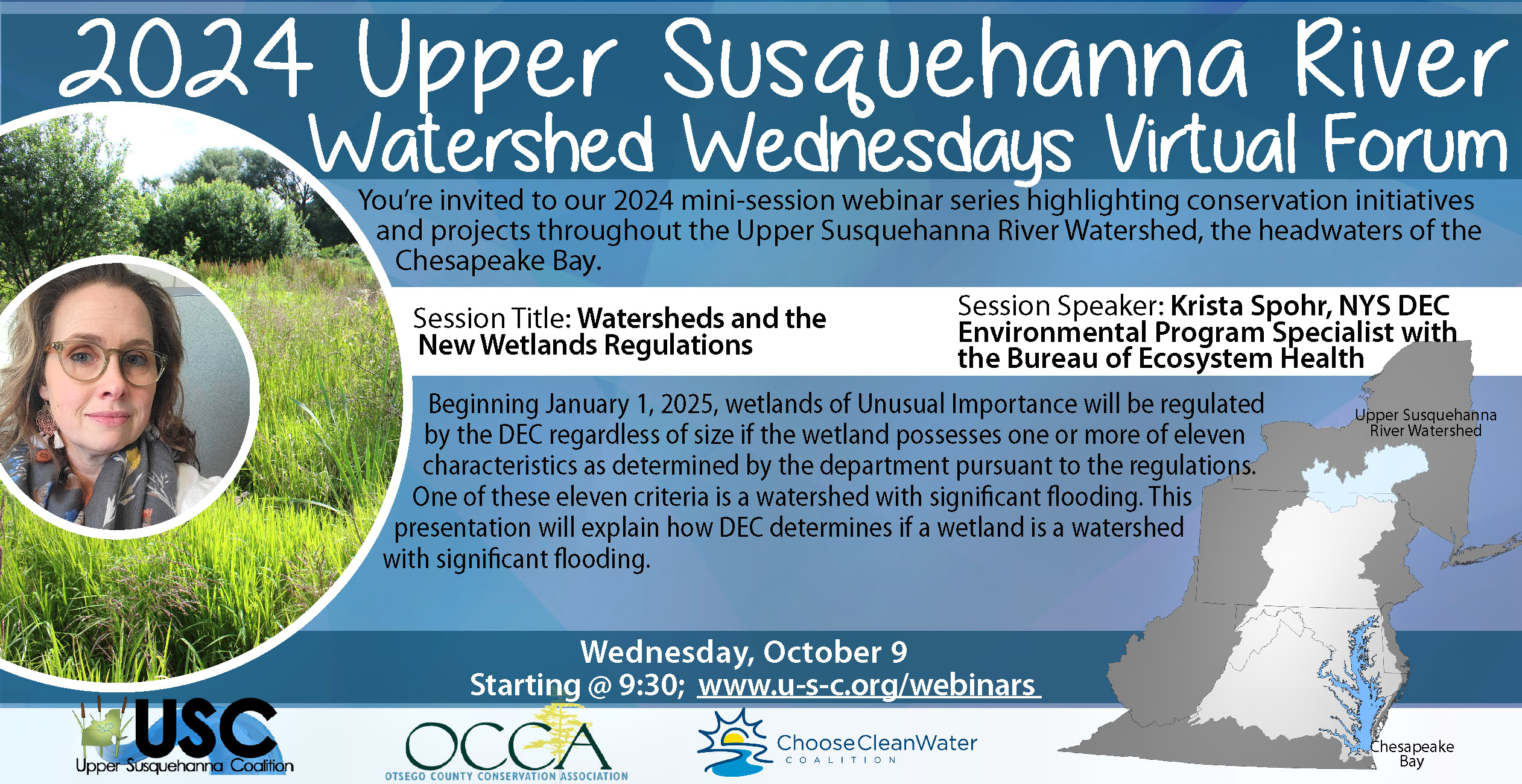
October 9th
Beginning January 1, 2025, wetlands of Unusual Importance will be regulated by the DEC regardless of size if the wetland possesses one or more of eleven characteristics as determined by the department pursuant to the regulations. One of these eleven criteria is a watershed with significant flooding. This presentation will explain how DEC determines if a wetland is a watershed with significant flooding.
.
.
.
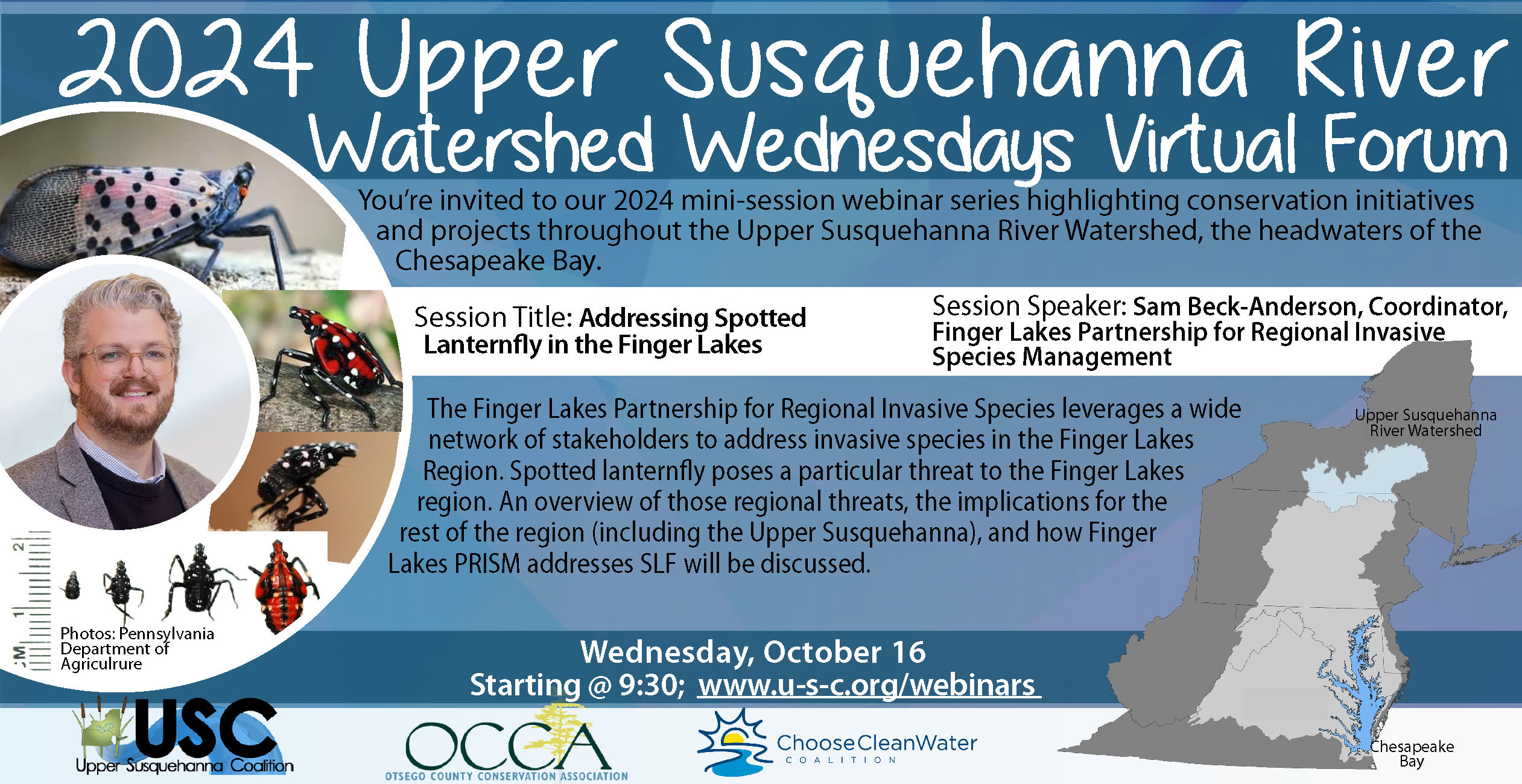
October 16th
The Finger Lakes Partnership for Regional Invasive Species leverages a wide network of stakeholders to address invasive species in the Finger Lakes Region. Spotted lanternfly poses a particular threat to the Finger Lakes region. This presentation provides an overview of those regional threats, the implications for the rest of the region (including the Upper Susquehanna), and how Finger Lakes PRISM addresses SLF.
Webinar Resources:
Penn State Tree-of-Heaven Resource: https://extension.psu.edu/tree-of-heaven
SLF Honeydew Video: https://www.youtube.com/watch?v=771P9SZLb88&t
.
.
.
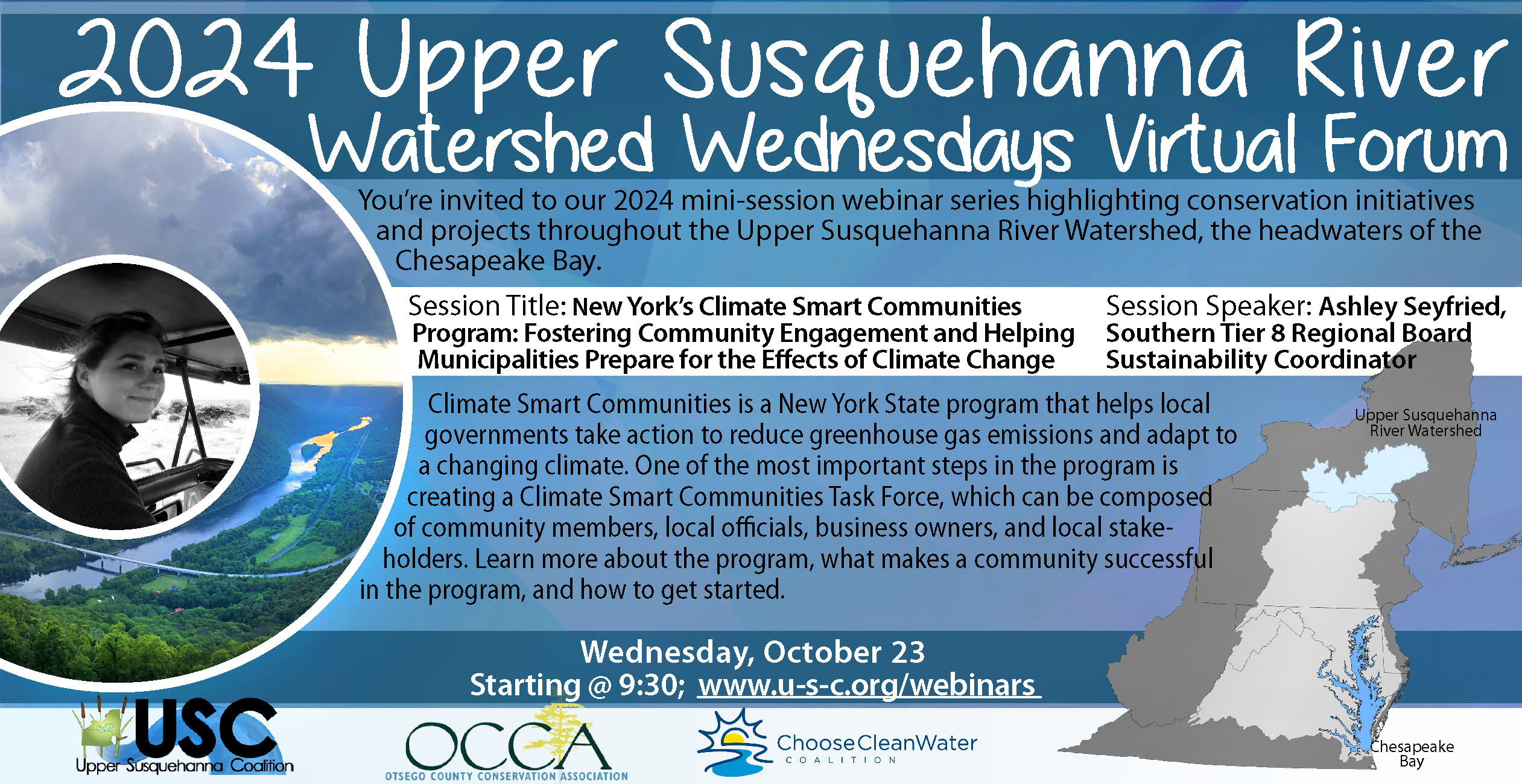
October 23rd
Climate Smart Communities is a New York State program that helps local governments take action to reduce greenhouse gas emissions and adapt to a changing climate. One of the most important steps in the program is creating a Climate Smart Communities Task Force, which can be composed of community members, local officials, business owners, and local stakeholders. Learn more about the program, what makes a community successful in the program, and how to get started.
.
.
.
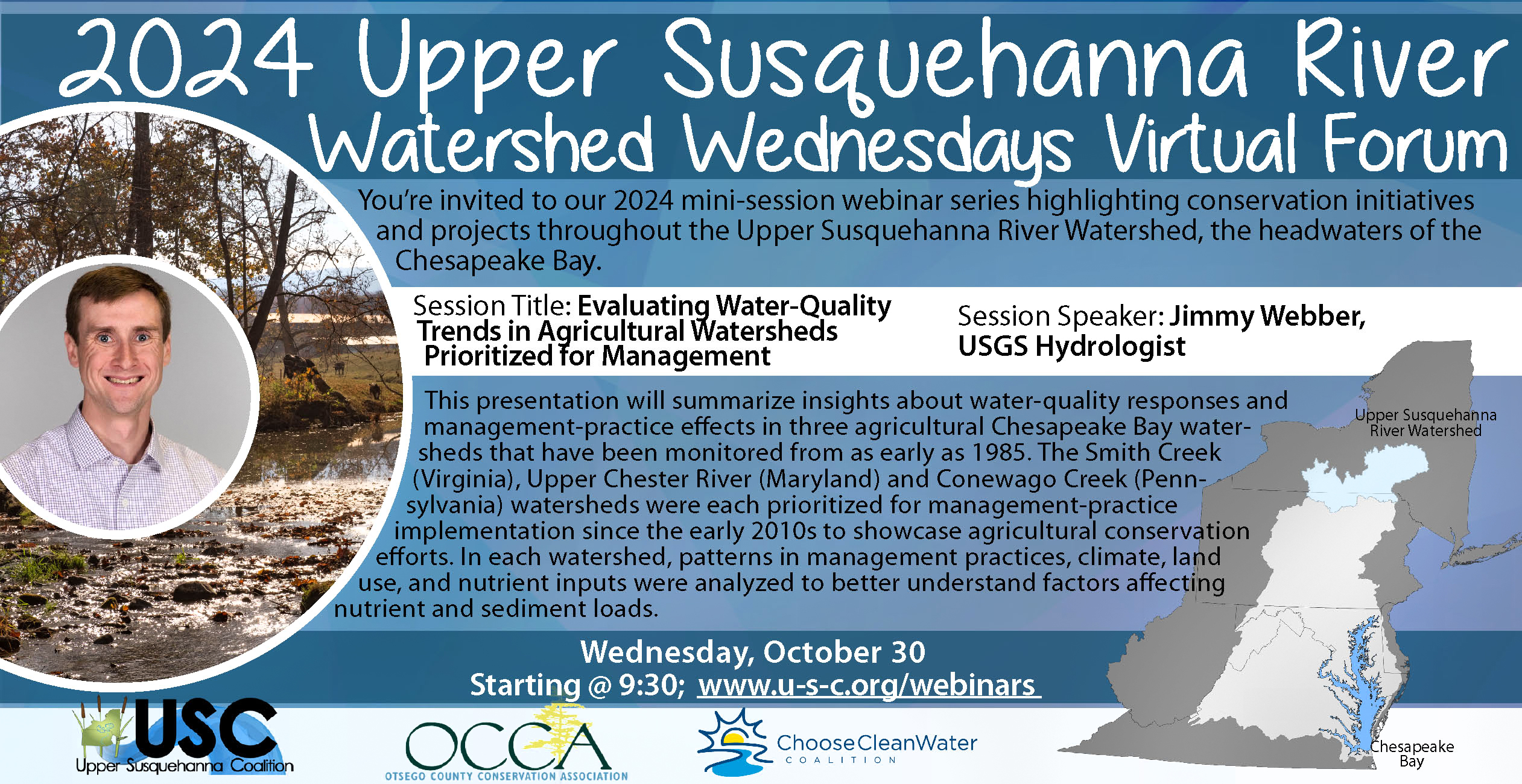
October 30th
This presentation will summarize insights about water-quality responses and management-practice effects in three agricultural Chesapeake Bay watersheds that have been monitored from as early as 1985. The Smith Creek (Virginia), Upper Chester River (Maryland) and Conewago Creek (Pennsylvania) watersheds were each prioritized for management-practice implementation since the early 2010s to showcase agricultural conservation efforts. In each watershed, patterns in management practices, climate, land use, and nutrient inputs were analyzed to better understand factors affecting nutrient and sediment loads.
More information about this work can be found here: https://www.usgs.gov/centers/chesapeake-bay-activities/science/new-insights-reducing-nutrient-and-sediment-loads
Find the research paper at this link: https://onlinelibrary.wiley.com/doi/10.1111/1752-1688.13197
.
.
.
November 6th
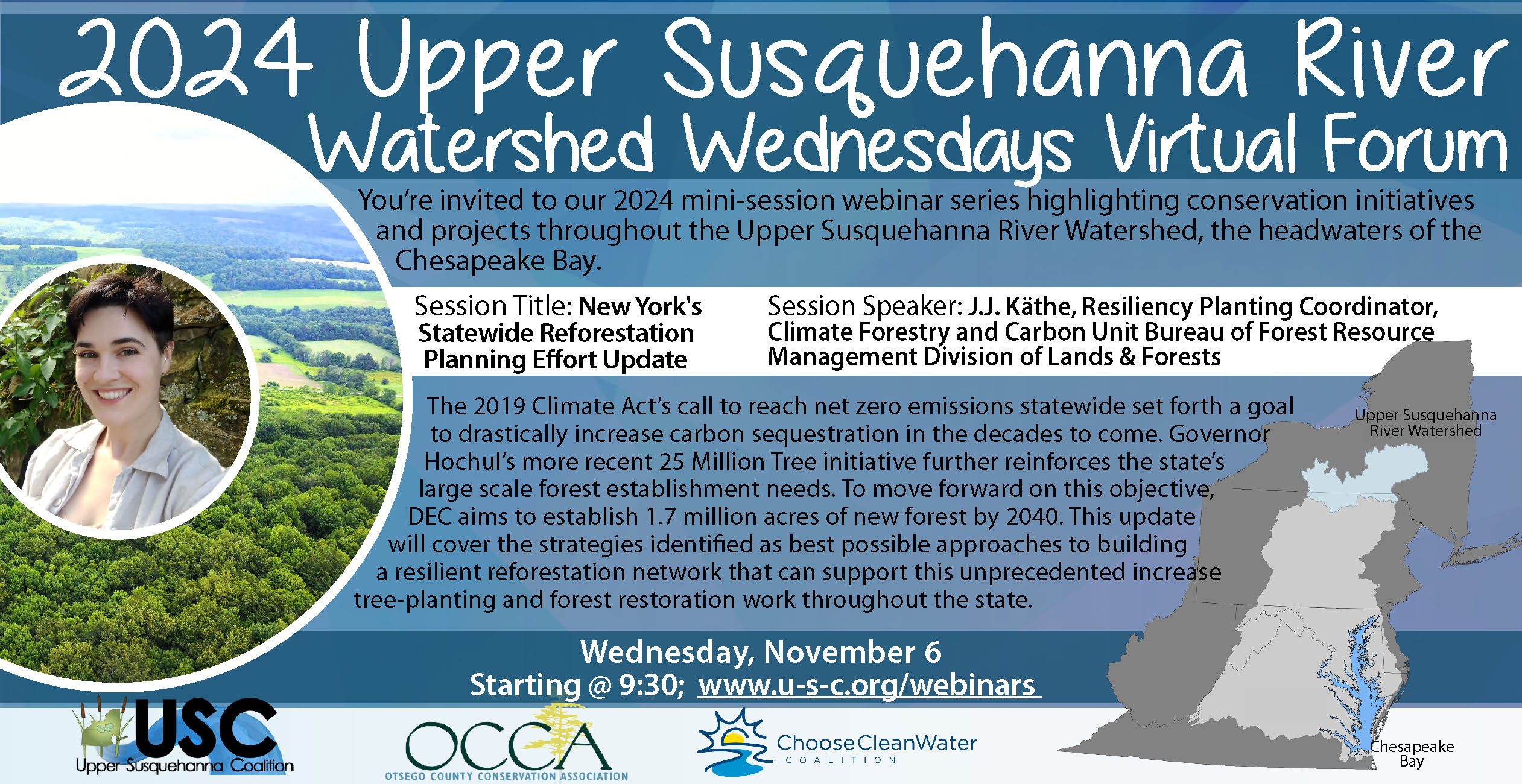
The 2019 Climate Act’s call to reach net zero emissions statewide set forth a goal to drastically increase carbon sequestration in the decades to come. Governor Hochul’s more recent 25 Million Tree initiative further reinforces the state’s large scale forest establishment needs. To move forward on this objective, DEC aims to establish 1.7 million acres of new forest by 2040. This update will cover the strategies identified as best possible approaches to building a resilient reforestation network that can support this unprecedented increase tree-planting and forest restoration work throughout the state.
Webinar Resources:
Reforestation Plan Dashboard – https://on.ny.gov/reforestation2024
Reforestation Coordinator Email – jessica.kathe@dec.ny.gov
.
.
.
November 13th
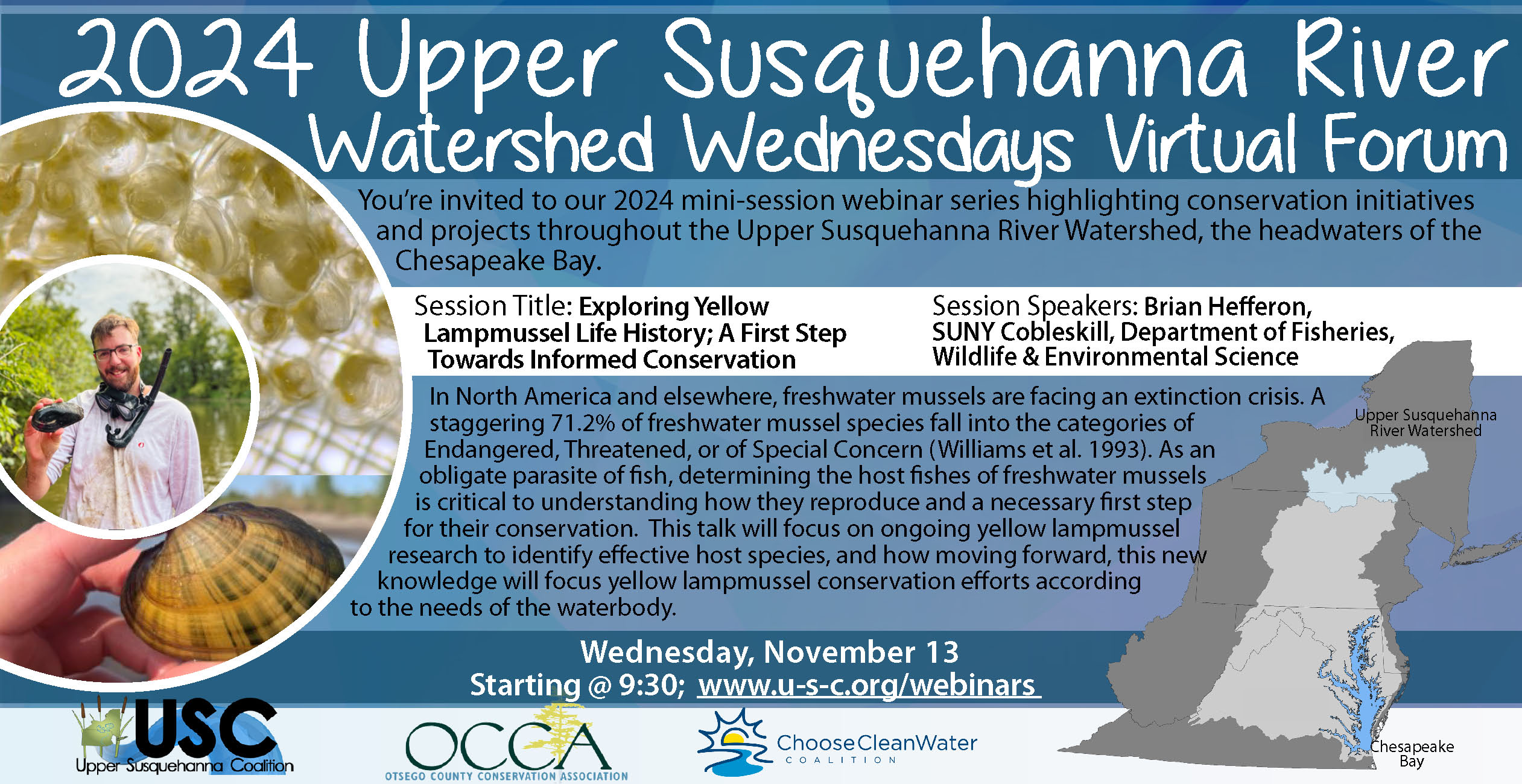
In North America and elsewhere, freshwater mussels are facing an extinction crisis. A staggering 71.2% of freshwater mussel species fall into the categories of Endangered, Threatened, or of Special Concern (Williams et al. 1993). As an obligate parasite of fish, determining the host fishes of freshwater mussels is critical to understanding how they reproduce and a necessary first step for their conservation. Despite a focus on this critical component of life history, host use remains undescribed for approximately 170 of North America’s 300 mussel species (Haag 2012). The yellow lampmussel (Lampsilis cariosa) is a freshwater mussel native to the Atlantic Slope drainages of North America that requires further investigation of its host use. To determine the potential host fishes used by yellow lampmussel, 22 species of fish were infested with larval yellow lampmussel. Smallmouth bass (Micropterus dolomieu), black crappie (Pomoxis nigromaculatus), walleye (Sander vitreus), and brook trout (Salvelinus fontinalis) were the most effective hosts. This new knowledge of their host use will focus yellow lampmussel conservation efforts according to the needs of the waterbody.
.
.
.
November 20th
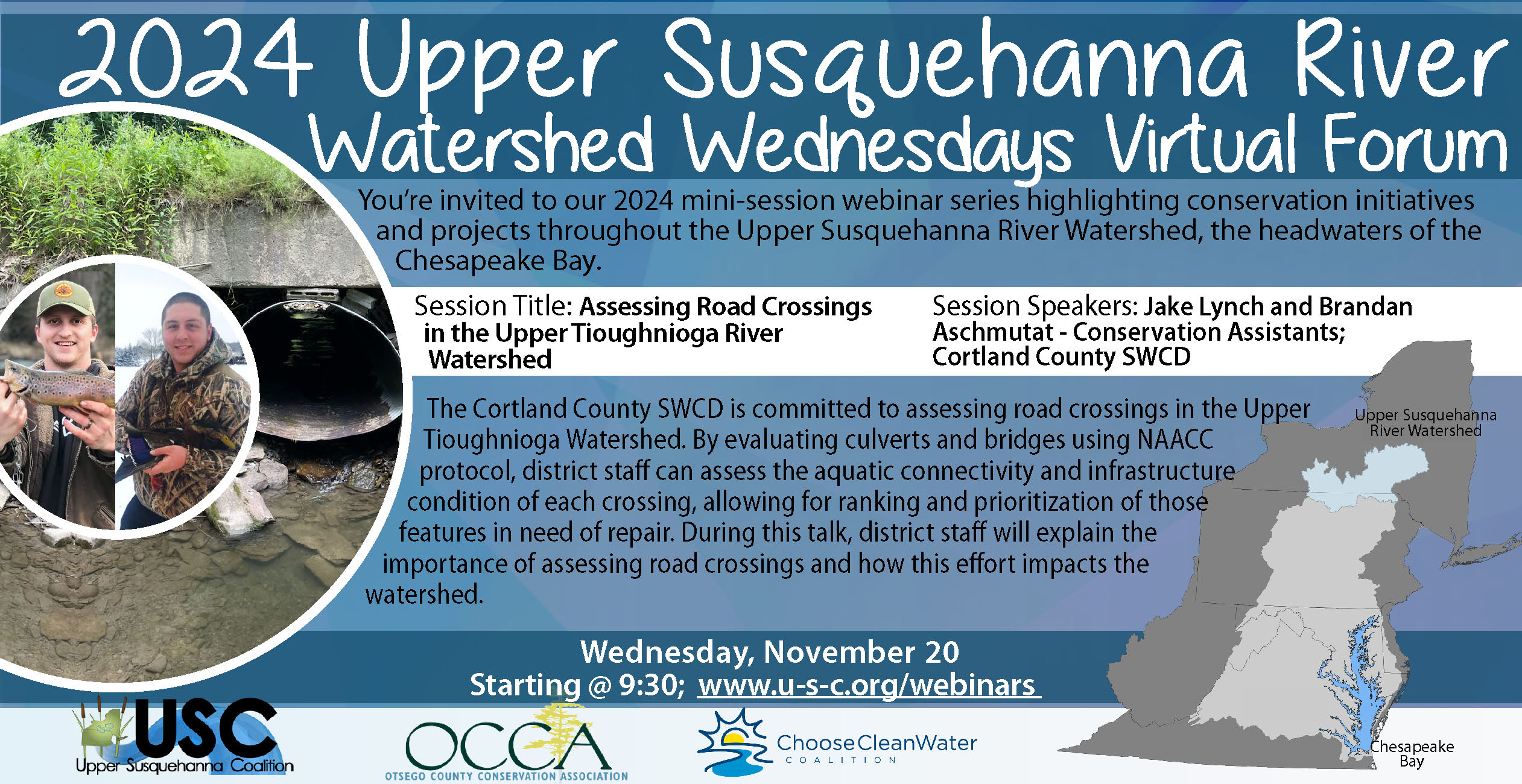
The Cortland County SWCD is committed to assessing road crossings in the Upper Tioughnioga Watershed. By evaluating culverts and bridges using NAACC protocol, district staff can assess the aquatic connectivity and infrastructure condition of each crossing, allowing for ranking and prioritization of those features in need of repair. During this talk, presenters discuss the importance of assessing road crossings and how this effort impacts the watershed.
.
.
.
Watershed Wednesdays 2022 Resources
September 14th
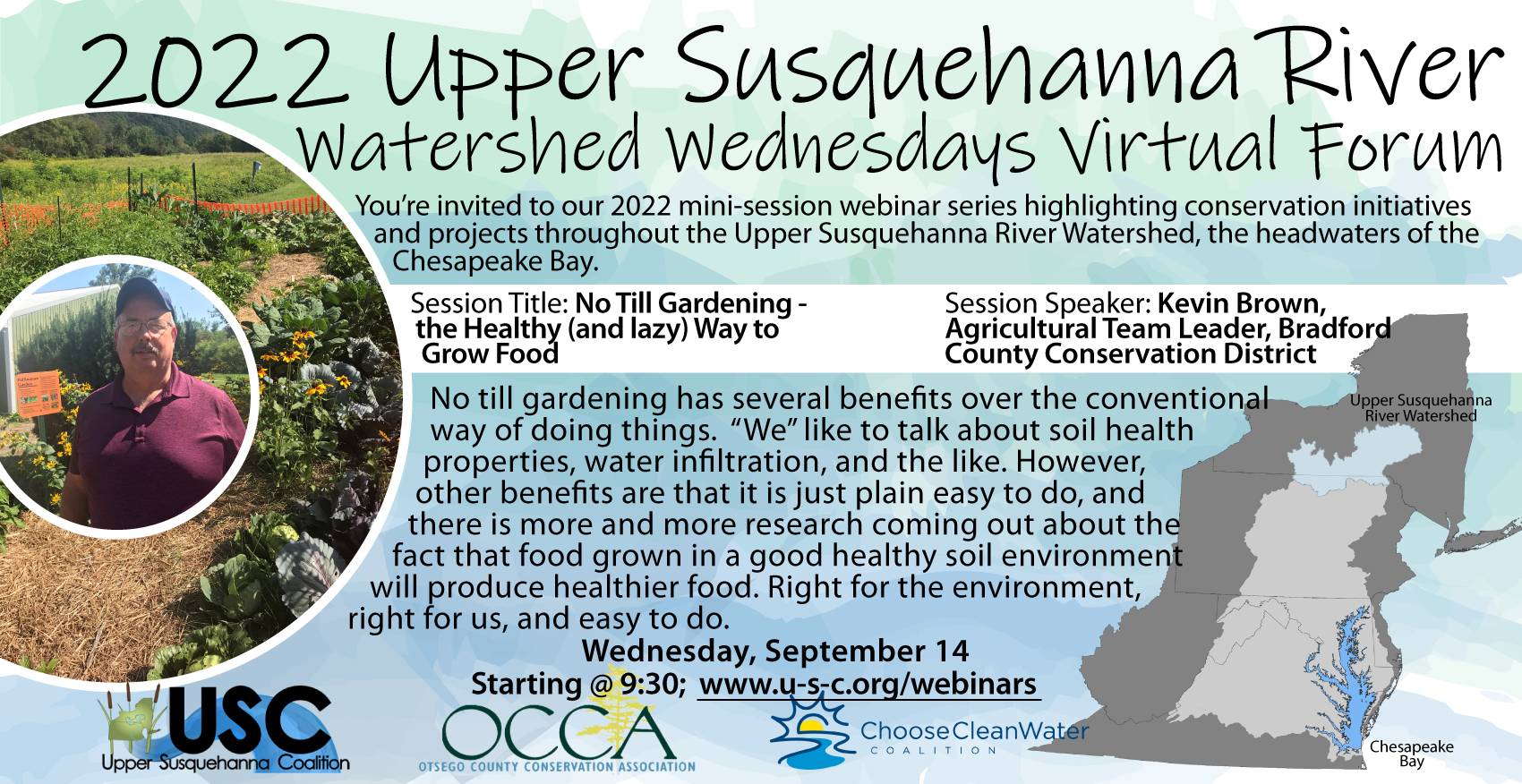
No till gardening allows us reap the benefits that we all talk to our producers about- no till, soil health, water infiltration, cover crops, mycorrizhal fungi, and everything else environmentally related, but yet also make gardening super easy. there is no rock picking, no tilling, no weeding, and virtually no watering (unless it happens to be a year like this year).
.
.
September 21st
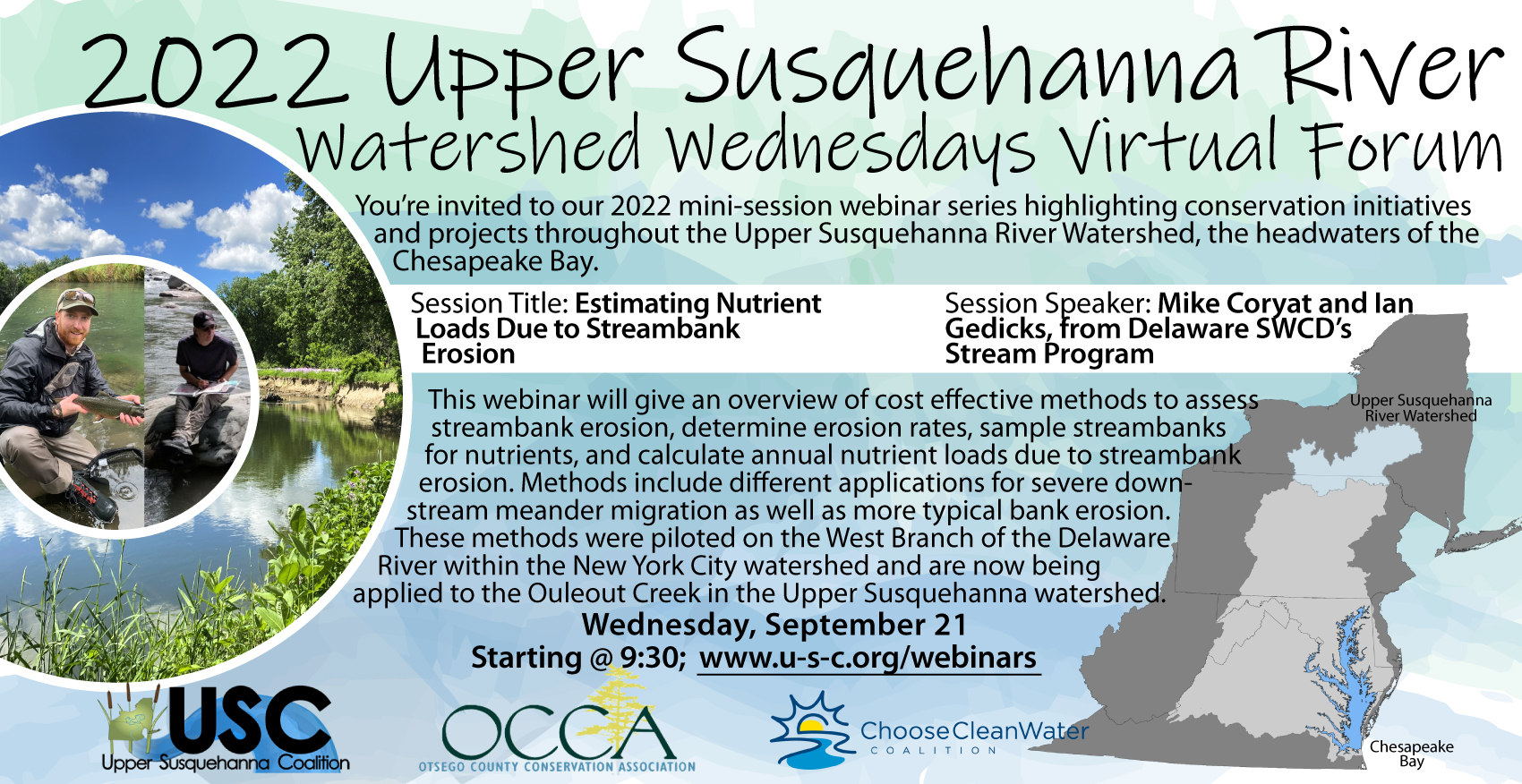
An overview of cost effective methods to assess streambank erosion, determine erosion rates, sample streambanks for nutrients, and calculate annual nutrient loads due to streambank erosion. Methods include different applications for severe downstream meander migration as well as more typical bank erosion. These methods were piloted on the West Branch of the Delaware River within the New York City watershed and are now being applied to the Ouleout Creek in the Upper Susquehanna watershed.
.
.
September 28th
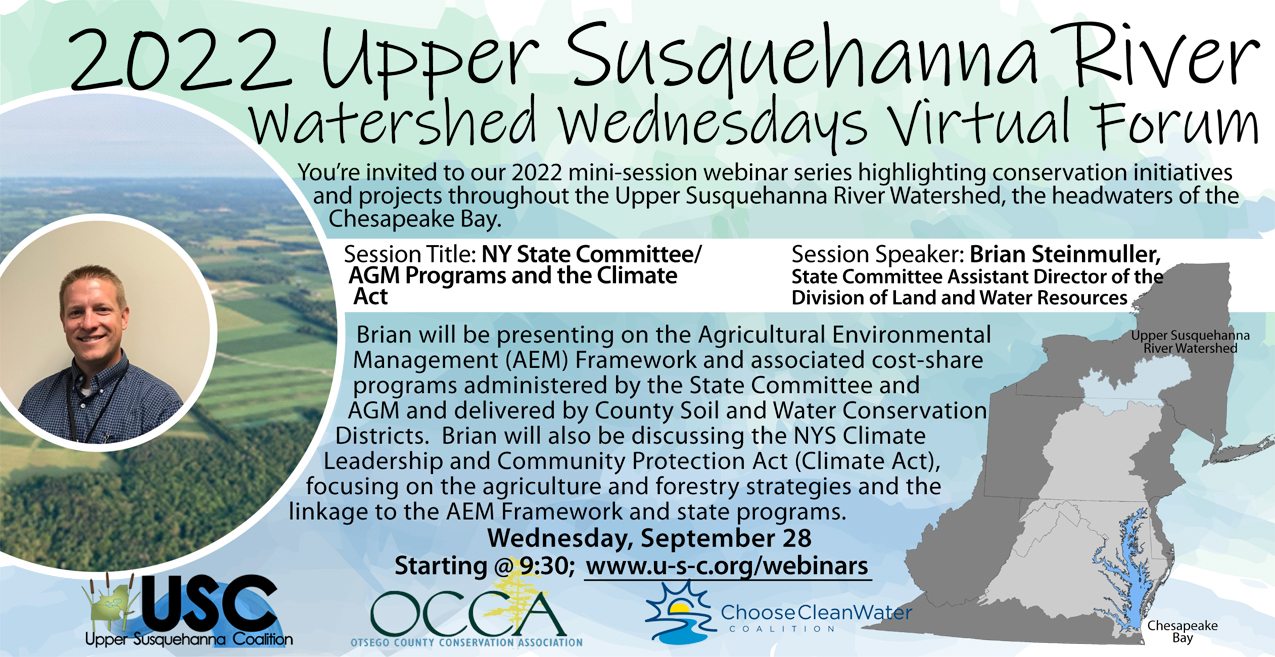
This session reviews the Agricultural Environmental Management (AEM) Framework and associated cost-share programs administered by the State Committee and AGM and delivered by County Soil and Water Conservation Districts. Brian will also be discussing the NYS Climate Leadership and Community Protection Act (Climate Act), focusing on the agriculture and forestry strategies and the linkage to the AEM Framework and state programs.
.
.
October 5th
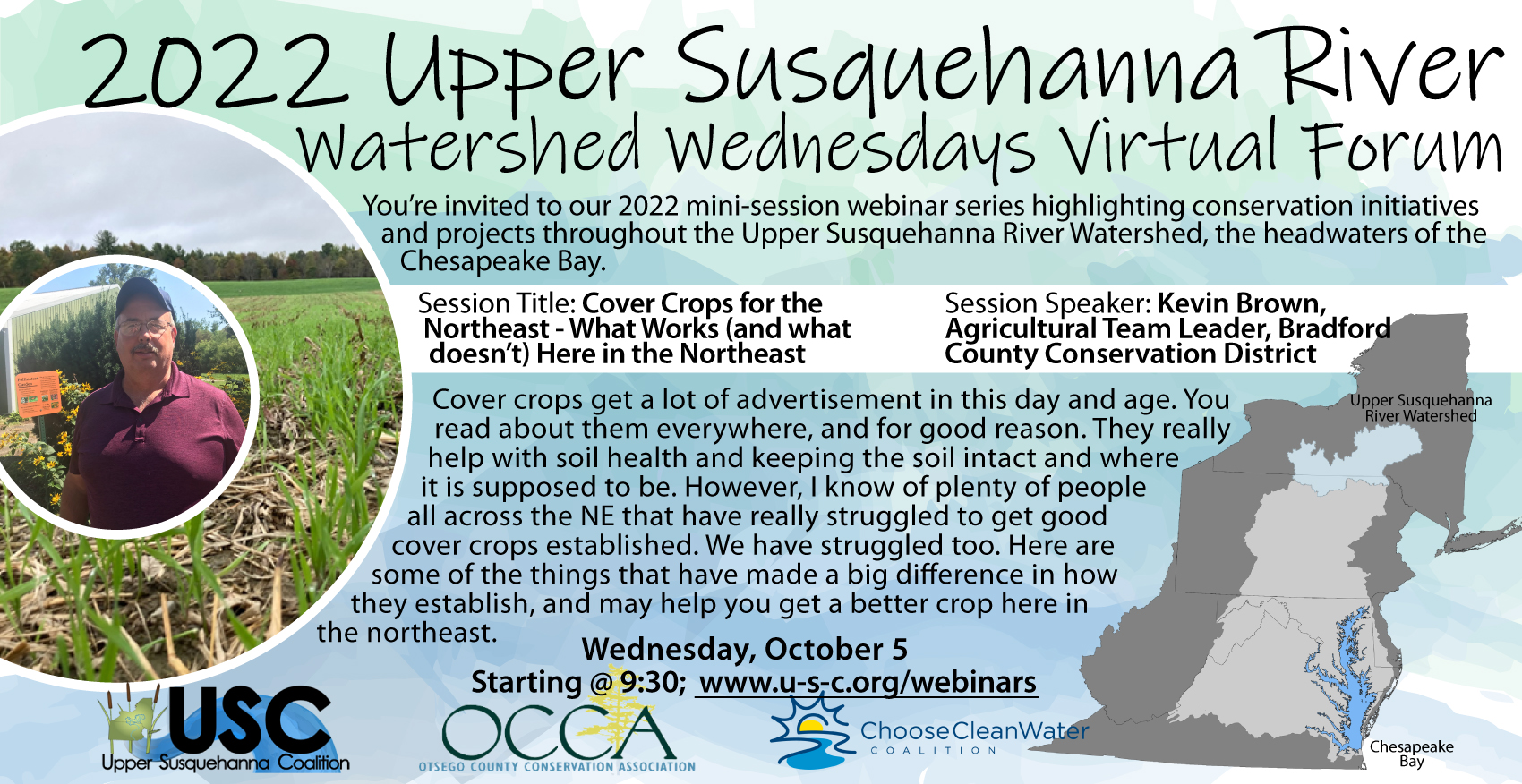
This session will review a number of cover crop improvement trials observed by Bradford County Conservation District staff. These include trials both with and without use of an interseeder, a side-by-side trial in partnership with PSU and there drill interseeder and lots of lessons learned. Learn what has worked for us, and more importantly what has not. The NE has a very short growing season, and trying to double crop by growing a cash crop and cover crop can be very challenging. We have discovered a few very important things that you need to do in order to be successful that you don’t usually hear about.
.
.
October 12th
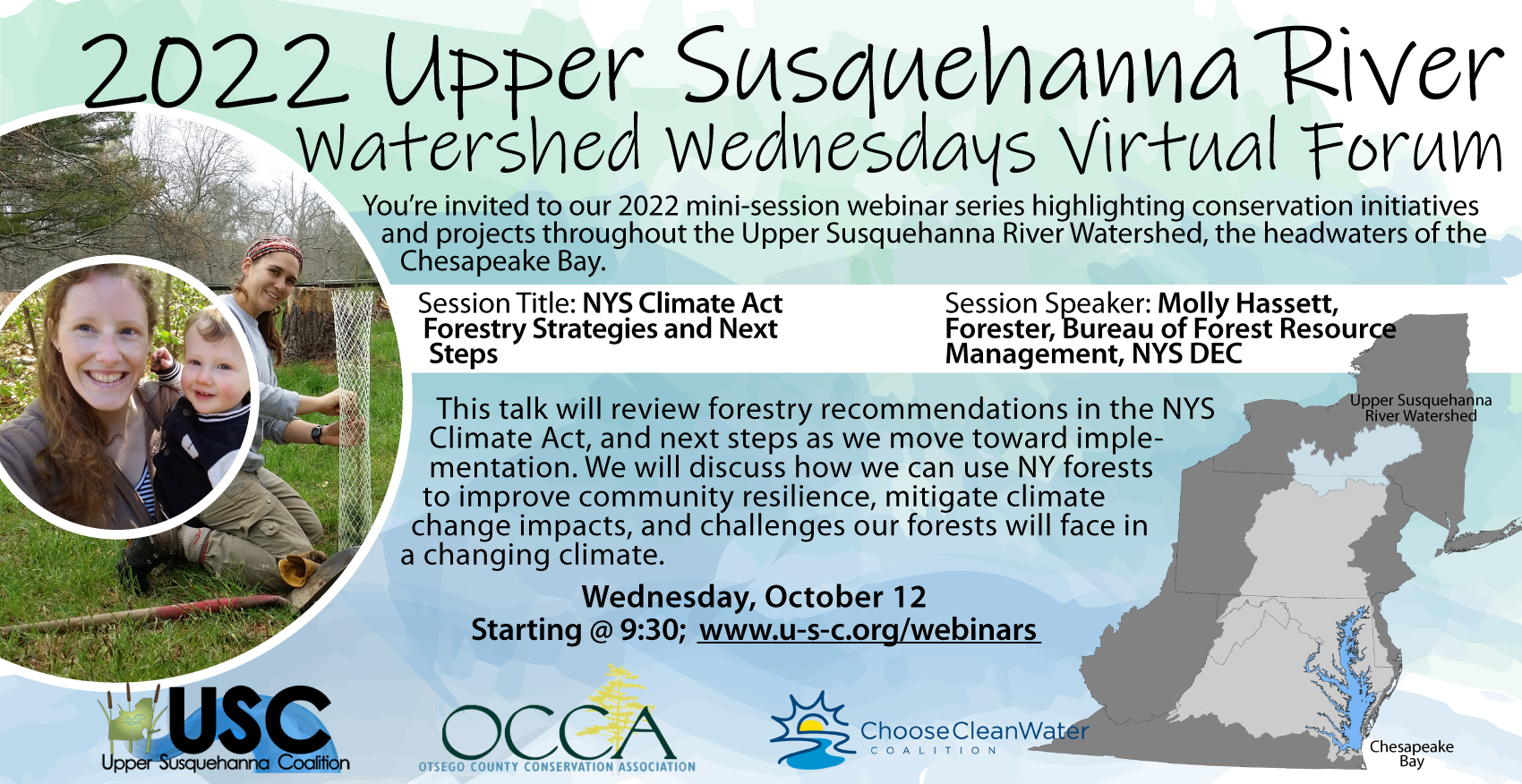
In our discussion we will talk about the Forestry recommendations in the NYS Climate Act and next steps as we move toward implementation. How we can use NY forests to improve community resilience, mitigate climate change, and prepare for a changing climate.
.
.
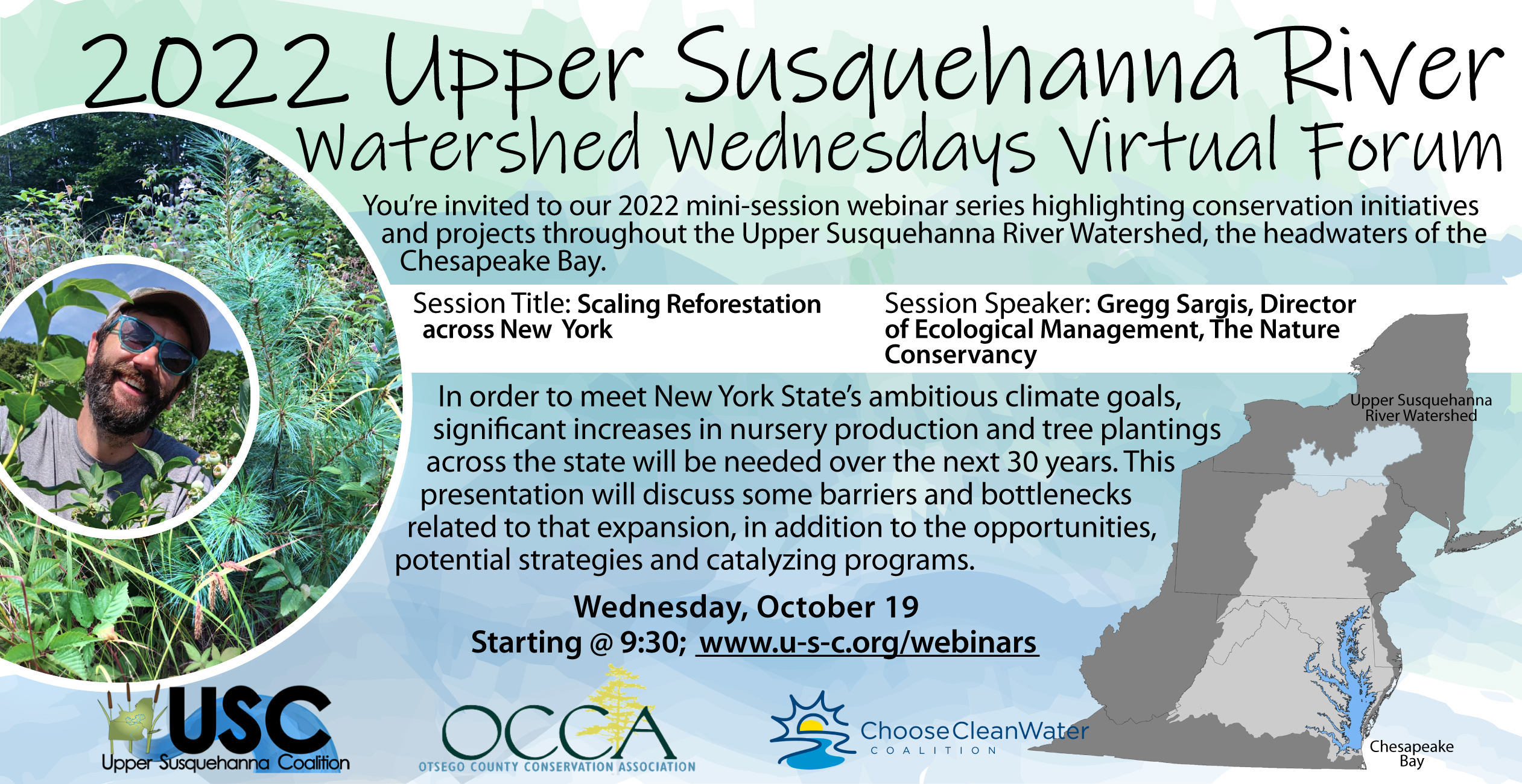
October 12th
In our discussion we will talk about the Forestry recommendations in the NYS Climate Act and next steps as we move toward implementation. How we can use NY forests to improve community resilience, mitigate climate change, and prepare for a changing climate.
.
.
October 26th
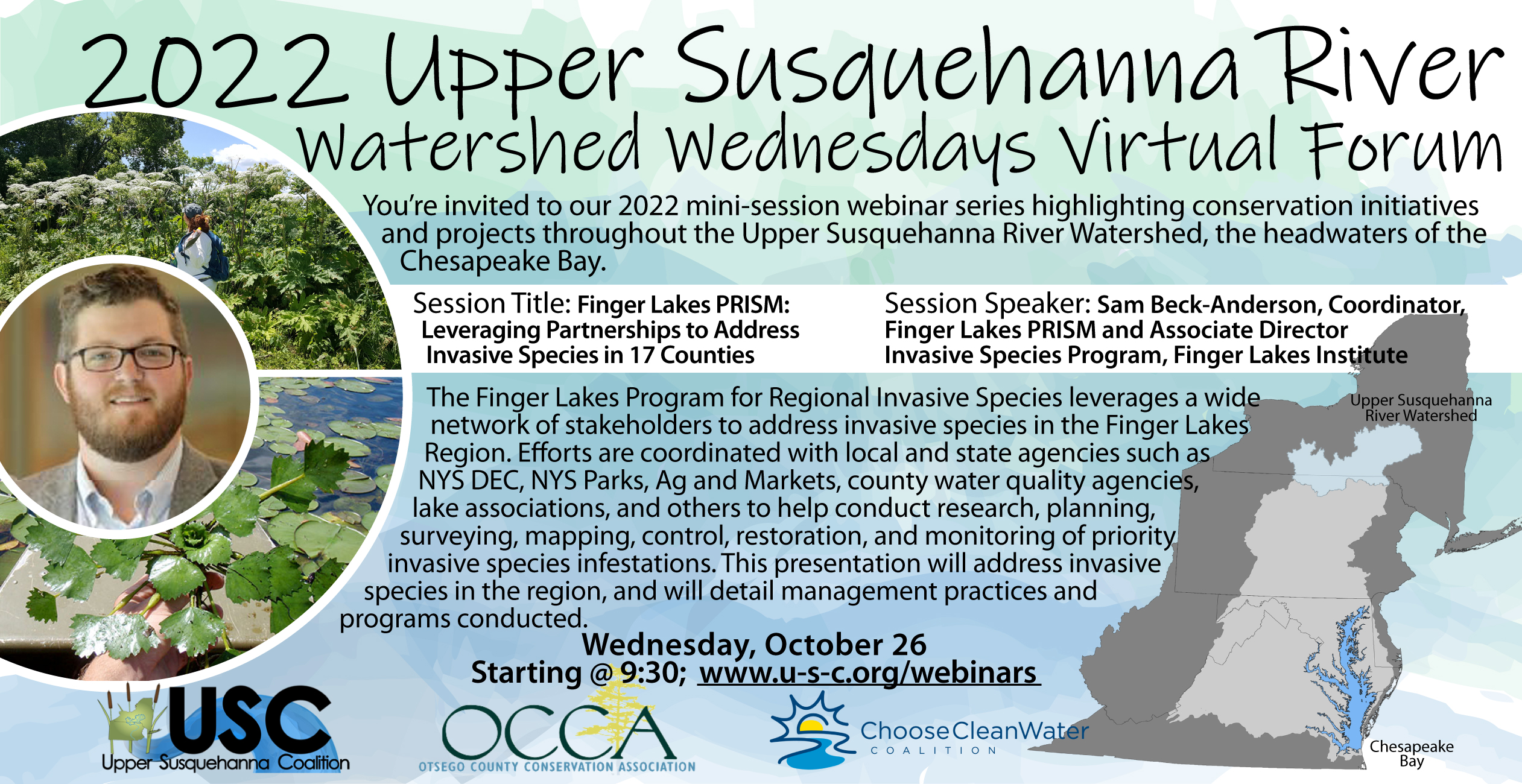
The Finger Lakes Partnership for Regional Invasive Species leverages a wide network of stakeholders to address invasive species in the Finger Lakes Region. Efforts are coordinated with local and state agencies such as NYS Department of Environmental Conservation, NYS Parks, Ag and Markets, county water quality agencies, lake associations, and others to help conduct research, planning, surveying, mapping, control, restoration, and monitoring of priority invasive species infestations. This presentation will address invasive species in the region, and will detail management practices and programs conducted.
.
.
November 2nd
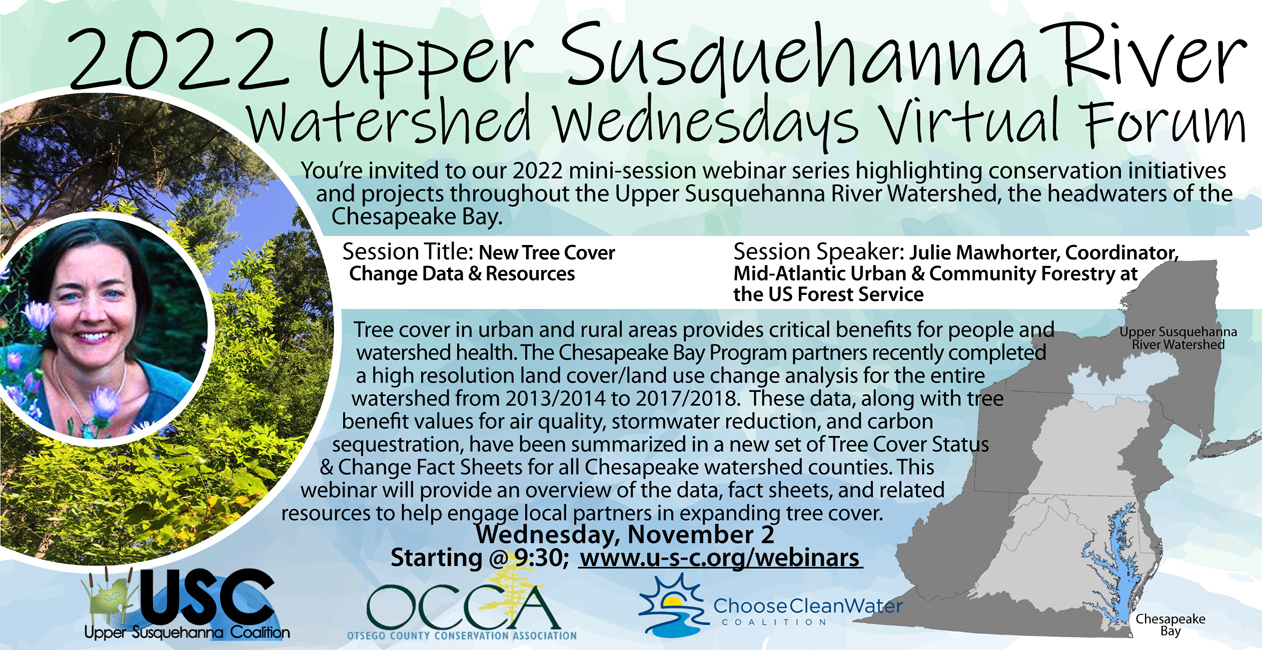
Tree cover in urban and rural areas provides critical benefits for people and watershed health. The Chesapeake Bay Program partners recently completed a high resolution land cover/land use change analysis for the entire watershed from 2013/2014 to 2017/2018. These data, along with tree benefit values for air quality, stormwater reduction, and carbon sequestration, have been summarized in a new set of Tree Cover Status & Change Fact Sheets for all Chesapeake watershed counties. This webinar will provide an overview of the data, fact sheets, and related resources to help engage local partners in maintaining and expanding tree cover.
.
.
Watershed Wednesdays 2021 Resources
August 4th
Troy and Connecticut young farmer, John Suscovich, discuss and showcase practical pasture management tools. From planning, mapping, measuring and implementing a real-time grazing strategy, attendees can see how an actual 2021 grazing plan takes shape on the land. Spoiler Alert: Enjoy the random outtakes.
.
.
August 11th
This webinar discusses USC’s partnership with the Finger Lakes Land Trust has evolved to include the collaborative permanent protection of riparian buffer plantings on both FLLT-owned nature preserves and on private property subject to permanent conservation easement. Our speaker, Kris West shares details of both project types.
.
.
.
August 18th
This webinar discusses the use of new underwater drone technology to connect people with the underwater worlds in their own backyards. View the video below for the webinar recording to learn more about the equipment, techniques, software and skills needed to create an exciting new underwater education platform or provide a unique underwater inspection service in your community.
.
.
.
.
August 25th
In this Watershed Wednesdays webinar Troy Bishopp, USC’s Grazing Specialist presents on 16 years of pasture water delivery scenarios. Troy takes a photojournal look at the many diverse situations and solutions implemented by the district and practical farmers in our watershed.
.
.
.
.
September 1st
Targeting outreach and assistance to agricultural producers in small watersheds with headwaters streams provides the possibility for faster improvements in water quality and stream health, than non-targeted efforts. At the same time, such targeting brings added challenges and costs. Stroud Water Research Center will share their experiences, including monitoring efforts before, during and after implementation.
.
.
.
.
September 8th
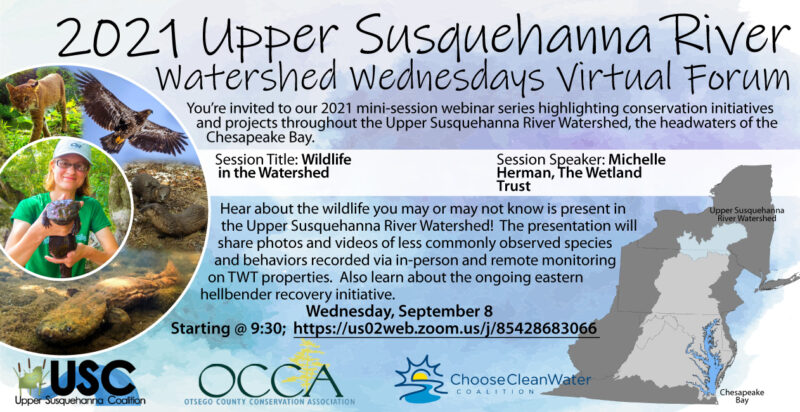
Hear about the wildlife you may or may not know is present in the Upper Susquehanna River Watershed! The presentation will share photos and videos of less commonly observed species and behaviors recorded via in-person and remote monitoring on TWT properties. Also learn about the ongoing eastern hellbender recovery initiative.
.
.
.
.
September 15th
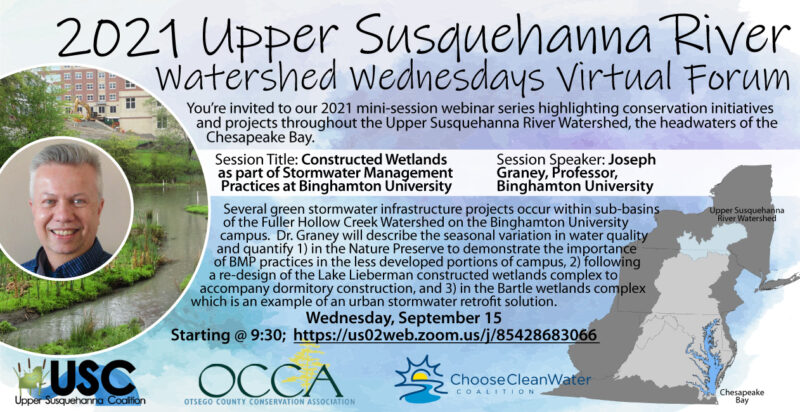
Several green stormwater infrastructure projects occur within sub-basins of the Fuller Hollow Creek Watershed on the Binghamton University campus. Dr. Graney will describe the seasonal variation in water quality and quantify 1) in the Nature Preserve to demonstrate the importance of BMP practices in the less developed portions of campus, 2) following a re-design of the Lake Lieberman constructed wetlands complex to accompany dormitory construction, and 3) in the Bartle wetlands complex which is an example of an urban stormwater retrofit solution.
.
.
.
.
September 22nd
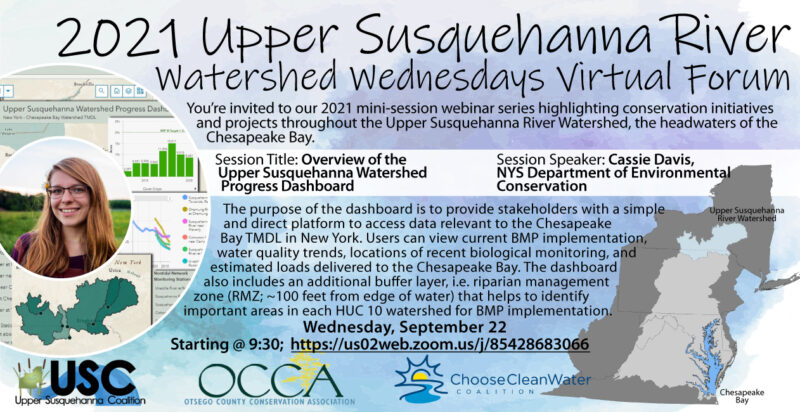
The purpose of the dashboard is to provide stakeholders with a simple and direct platform to access data relevant to the Chesapeake Bay TMDL in New York. Users can view current BMP implementation, water quality trends, locations of recent biological monitoring, and estimated loads delivered to the Chesapeake Bay. The dashboard also includes an additional buffer layer, i.e. riparian management zone (RMZ; ~100 feet from edge of water) that helps to identify important areas in each HUC 10 watershed for BMP implementation.
.
.
.
.
September 29th
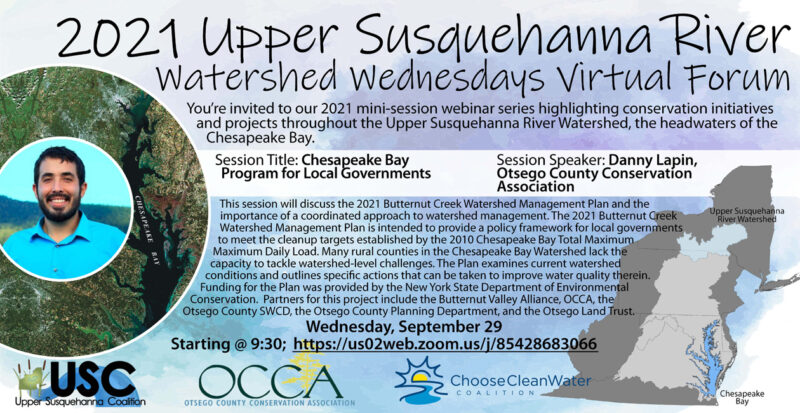
This session will discuss the 2021 Butternut Creek Watershed Management Plan and the importance of a coordinated approach to watershed management. The 2021 Butternut Creek Watershed Management Plan is intended to provide a policy framework for local governments to meet the cleanup targets established by the 2010 Chesapeake Bay Total Maximum Daily Load. Many rural counties in the Chesapeake Bay Watershed lack the capacity to tackle watershed-level challenges. The Plan examines current watershed conditions and outlines specific actions that can be taken to improve water quality therein. Funding for the Plan was provided by the New York State Department of Environmental Conservation. Partners for this project include the Butternut Valley Alliance, OCCA, the Otsego County SWCD, the Otsego County Planning Department, and the Otsego Land Trust.
.
.
.
.
October 6th
This presentation will discuss how to stabilize streambeds that are actually in the process of a headcut.
.
.
.
.
October 11th
This presentation will discuss different options and case scenario in the workings of trying to stabilize road ditches. Also will share a draft of information for municipalities on how to develop a road ditch management system.
.
.
.
.
October 20th
This webinar discusses a project that tells the stories of Black landowners in the northeast in their own words. The research team will interview Black landowners, with an emphasis on New York State, to learn about their unique experiences as landowners in the northeast. Much of what is known about Black landowner experience and ties to the land comes from southern studies. The team will document and share stories and to gain a regional perspective about the issues they face, strategies to combat land loss, and incentives for becoming landowners. Interviews will cover topics such as: how they acquired their land, stewardship goals, obstacles faced, organizations that have helped or hindered their goals, and opportunities moving forward.
.
.
.
.
October 27th
Lack of technical knowledge to effectively implement restoration projects. Confusion surrounding the ambiguities of lobbying public officials. Inexperience with incorporating DEIJ practices within an organization. These are just a few examples of capacity gaps the Choose Clean Water Coalition and the Alliance for the Chesapeake Bay are working to identify and address in a new project throughout the Chesapeake Bay community. Working in collaboration with respected research and strategy firm OpinionWorks, the project is highlighted by a comprehensive survey and a series of investigative roundtables. Join this session to hear preliminary findings from the surveys and learn how you can get involved to increase the collective capacity of all organizations fighting for clean water throughout the Chesapeake Bay watershed.
.
.
.
.
Watershed Wednesdays 2020
With four consecutive years of Watershed Forums hopscotching across the watershed and changing in focus, size and scope, the changes in the 2020 group meetings climate encouraged our planning team to shift gears completely in preparation for the 2020 Upper Susquehanna Watershed Forum. Rather than a centralized one-day meeting, the 2020 forum morphed into mini-sessions every Wednesday through July and August for Round 1, and in November and December (aside from holidays) for Round 2. The mini-session format was designed to encourage participation without interrupting busy schedules or requiring travel. These sessions were focused on a variety of topics related to the watershed, conservation initiatives, and ongoing projects, and video recordings are posted here for future perusal.
We hope you enjoy our 2020 Upper Susquehanna Watershed Forum!
Thanks to our partners and members for assisting in developing Watershed Wednesdays content and to Otsego County Conservation Association for hosting the webinars and providing video recordings.
2020 Webinar Calendar:

Return to the main Watershed Wednesdays page
Return to the main Watershed Wednesdays page
Watershed Wednesdays 2020
With four consecutive years of Watershed Forums hopscotching across the watershed and changing in focus, size and scope, the changes in the 2020 group meetings climate encouraged our planning team to shift gears completely in preparation for the 2020 Upper Susquehanna Watershed Forum. Rather than a centralized one-day meeting, the 2020 forum morphed into mini-sessions every Wednesday through July and August for Round 1, and in November and December (aside from holidays) for Round 2. The mini-session format was designed to encourage participation without interrupting busy schedules or requiring travel. These sessions were focused on a variety of topics related to the watershed, conservation initiatives, and ongoing projects, and video recordings are posted here for future perusal.
We hope you enjoy our 2020 Upper Susquehanna Watershed Forum!
Thanks to our partners and members for assisting in developing Watershed Wednesdays content and to Otsego County Conservation Association for hosting the webinars and providing video recordings.
2020 Webinar Calendar:
Return to the main Watershed Wednesdays page
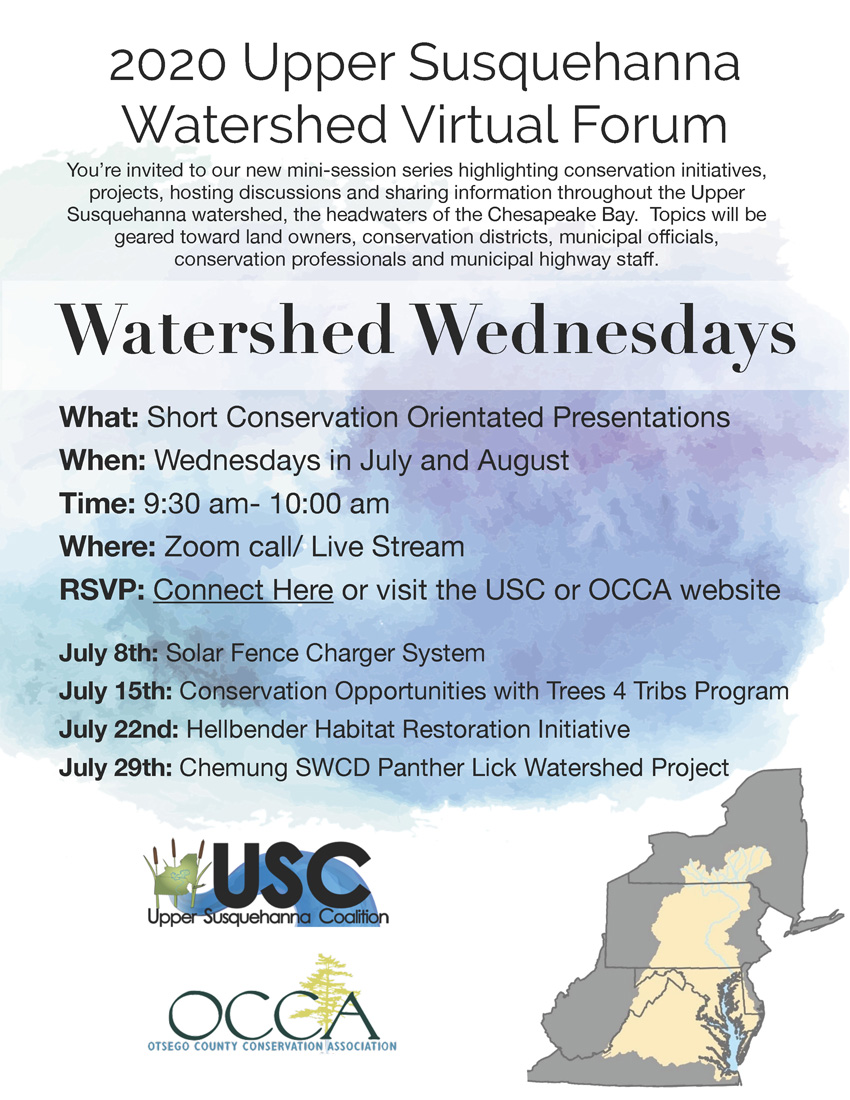
July 9:
This week’s Watershed Wednesdays topic is the installation of a solar fence charger system and led by Troy Bishopp, our own grass whisperer.
July 15:
This week’s Watershed Wednesdays topic is the New York State’s Trees for Tributaries program. Learn how we can help you get trees and shrubs planted alongside a waterway on your land. This webinar is specifically for landowners and municipalities to understand how Trees for Tributaries an opportunity to engage in reforestation, decrease erosion, reduce flooding damage, improve wildlife habitat and protect water quality.
July 22:

Watershed Wednesdays Week 3
This week’s Watershed Wednesdays topic is a Hellbender Update, and will include a discussion about the ongoing in-stream cover rocks habitat improvement project. USC completed a cover rock habitat improvement project in 2018 prior to the release of juvenile hellbenders with moderate success. Some juveniles were documented utilizing the habitat but the stream conditions are not optimal at this time for long term occupancy. The Wetland Trust (TWT) was able to secure an additional parcel of land that has afforded us the ability to expand the cover rocks upstream into areas with more ideal stream conditions. Approximately 100 slab rocks are stockpiled on-site and are scheduled to be installed in August and ahead of the release of the next cohort of juvenile hellbender scheduled for 2021. On behalf of TWT, USC has received authorization from the USACE and obtained coverage under DEC Article 15 stream disturbance permit.
July 29:

Watershed Wednesdays Week 4
This week’s Watershed Wednesdays topic is a large and diverse project improving stream sustainability in an important trout stream in our region. Chemung SWCD will discuss ongoing projects to support fish passage, improve floodplain health, protect streamside areas from flooding and protect eroding streambanks.
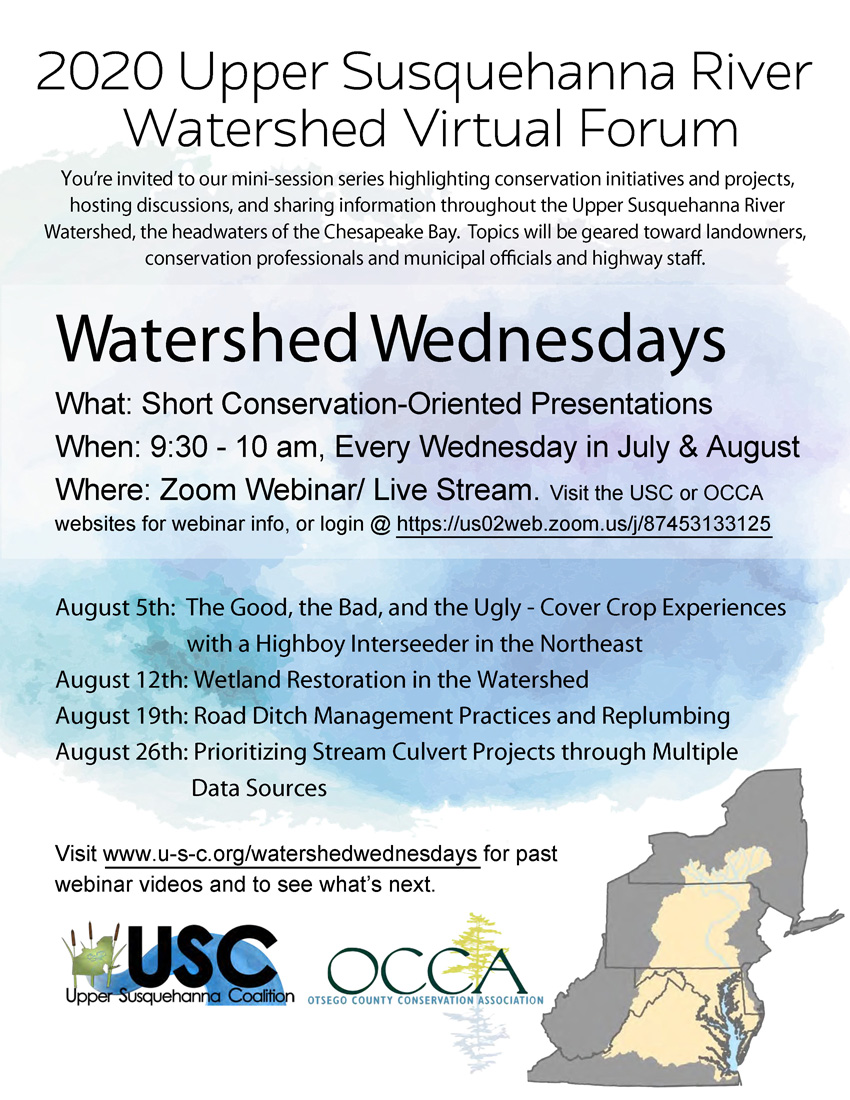
August 5:
Watershed Wednesdays Week 5
This week’s Watershed Wednesdays topic is cover crops. Cover cropping is probably the most important thing you can do to keep soil and nutrients where they should be, in your field where you can utilize them. However, establishing them in the NE has been challenging. We have operated an inter-seeder for 2 years now and have learned some extremely valuable lessons that will help you in your quest to grow good cover crops. Join us on the 5th to discuss what variables we should be looking at to establish good cover crops.
August 12:
Watershed Wednesdays Week 6
This week’s Watershed Wednesdays topic is wetland restoration, an important component of our watershed management and nutrient reduction efforts. The USC Wetland team will discuss wetland restoration methods, tools and why wetlands should be an important landscape management tool.
August 19:
Watershed Wednesdays Week 7
This week’s Watershed Wednesdays topic is road ditch management practices and replumbing. David Orr, PE from Cornell University and the Local Roads Program will discuss their survey of ditch management practices in NYS, an example of a watershed replumbing project in a local county, and some work being done with student interns this summer.
August 26:
Watershed Wednesdays Week 8
This week’s Watershed Wednesdays topic is prioritizing stream culvert projects through multiple data sources.
Cortland County SWCD has incorporated multiple assessments and datasets to help ensure a holistic and systematic approach to culvert replacement projects addressing habitat and public infrastructure issues. This presentation describes the use of the I4 Assessment, NAACC, Cornell Culvert Model, and Culvert Condition to prioritize culvert and aquatic organism passage projects.
The following is a list of related resources:
North Atlantic Aquatic Connectivity Collaborative: https://streamcontinuity.org/naacc
- Culvert Condition Data Sheet https://streamcontinuity.org/sites/streamcontinuity.org/files/pdf-doc-ppt/Culvert%20Assessment%20Form_2019_082319.pdf
- Conservation Assessment and Prioritization System (CAPS): http://umasscaps.org/index.html
- Critical Linkages Project Description: http://www.umasscaps.org/applications/critical-linkages.html
- NY Data for CAPS and Critical Linkages: http://www.umasscaps.org/data_maps/dsl.html#NY
The Nature Conservancy Datasets-
- Chesapeake and Northeast Aquatic Connectivity Project Description: Stops at NY border but contains rest of Chesapeake Bay watershed Online mapper that has assessed culvert passability (not sure if used NAACC data used) https://www.conservationgateway.org/ConservationByGeography/NorthAmerica/UnitedStates/edc/reportsdata/freshwater/stream/Pages/default.aspx
- Northeast Aquatic Connectivity Project Web Mapper: Online mapper that has assessed culvert passability (not sure if used NAACC or what Data was used) https://maps.freshwaternetwork.org/northeast/
- Active River Area: floodplain assessment looking at lands connected to streams during floods that might be worth protecting or looking into retention projects etc. https://www.conservationgateway.org/ConservationByGeography/NorthAmerica/UnitedStates/edc/reportsdata/freshwater/floodplains/Pages/default.aspx
- Lake Champlain Basic Road-Stream Crossing Assessment http://nyanc-alt.org/gis/Champlain/
Eastern Brook Trout Joint Venture: https://easternbrooktrout.org/assessment-data/brook-trout-assessment-data/ebtjv-sub-watersheds
Cornell Culvert Model: https://wri.cals.cornell.edu/sites/wri.cals.cornell.edu/files/shared/CornellCulvertsModelInstructions_RevisedAug2018.pdf
November 4:

Watershed Wednesdays Week 9
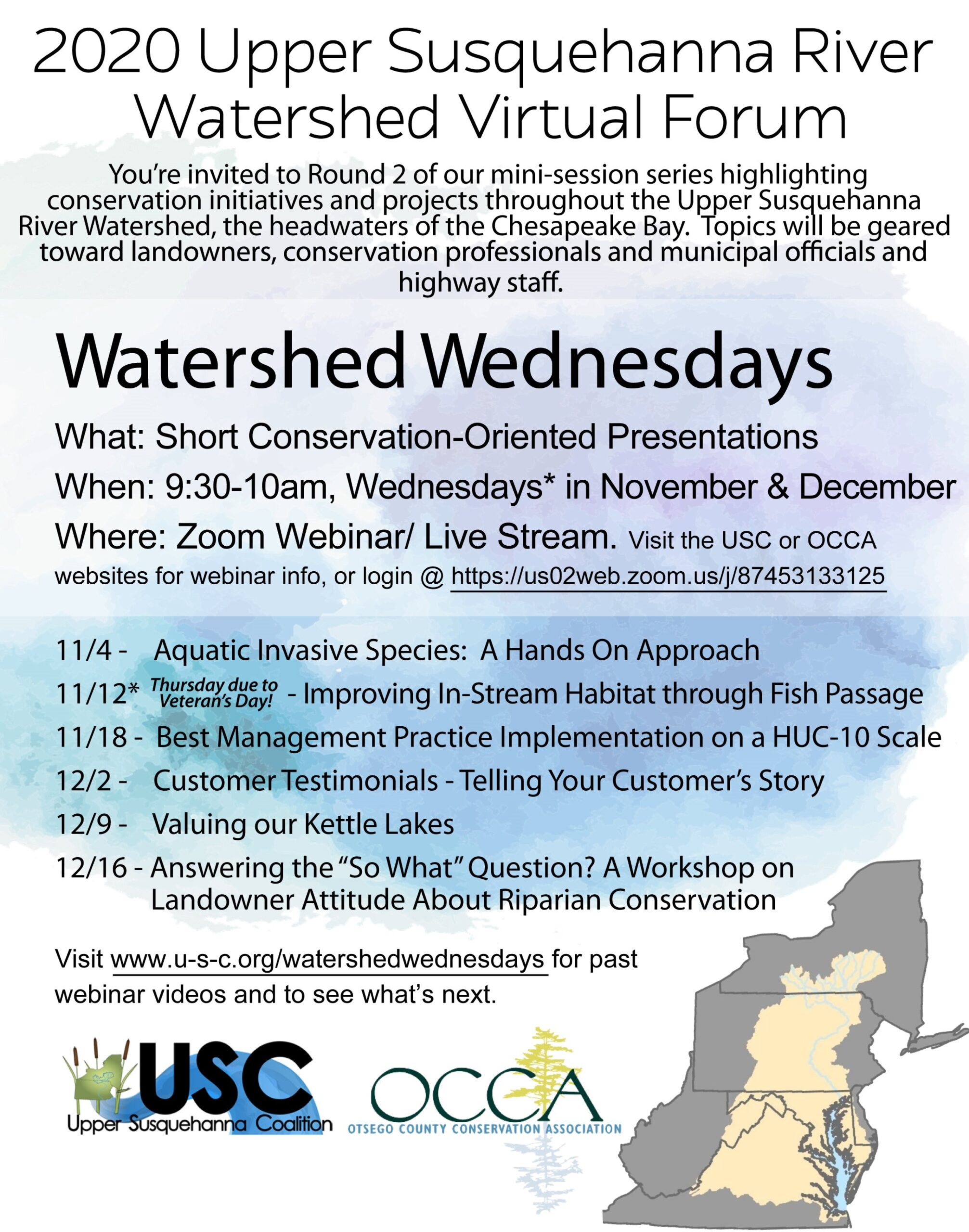
Since 2006, Otsego County Conservation Association has taken a hands-on approach when dealing with the problem of aquatic invasive species in several waterbodies. OCCA program director, Jeff O’Handley will review 15 years of AIS control projects in Otsego County and will discuss the pros and cons of OCCA’s experience – is the hands-on approach right for you?”
November 12* – our only Watershed Thursday of the series, due to Veteran’s Day:

Watershed Wednesdays Week 10
Steuben SWCD has been busy with fish passage projects in 2020. This talk will discuss recent projects, including culvert replacements and Engineered Rocked Riffles (ERR).
November 18:

This week’s Watershed Wednesdays topic is Best Management Practice Implementation on a HUC-10 Scale. The Upper Susquehanna Coalition have been actively implementing various best management practices (BMP) in southern New York, helping the state to reach its nutrient reduction targets as part of the Chesapeake Bay TMDL (Total Maximum Daily Load). We conducted a series of analyses to compare the relationships between BMP implementations and the water quality measurements collected through the Nontidal Network (NTN) gaging stations and the Rotating Integrated Basin Studies (RIBS). In addition, we sought to identify the proportion of land uses for each HUC10 as well as the land use proportions of an estimated riparian management zone in their respective HUC10 region.
December 2:

Don’t take our word for it, see what our “customers” have to say about working with their county Soil & Water Conservation Districts and the Upper Susquehanna Coalition. Telling your story is important in building credible relationships with customers and partners, and producing these videos gets the word out about how we are helping to improve water quality through various implementation projects throughout the Upper Susquehanna River Watershed.
December 9:

Watershed Wednesdays Week 13
Tarki Heath, Cortland-
December 16:

Watershed Wednesdays Week 14
How do we best encourage private landowners to implement conser
.
.